Therian Vocals
What are therian vocals?
A therian is a person who experiences being and identifies as a non-human animal on an integral, personal level.1"Therian vocals" refers to making the noises of one's theriotype (the animal one identifies with). Making these sounds can help a therian feel more connected to their animal self, or just be a lot of fun!This website is for therians, otherkin, furries, voice actors, or anyone interested in learning how to make animal vocalizations safely and easily, all while learning how the voice works!

Voice Fundamentals

Canines
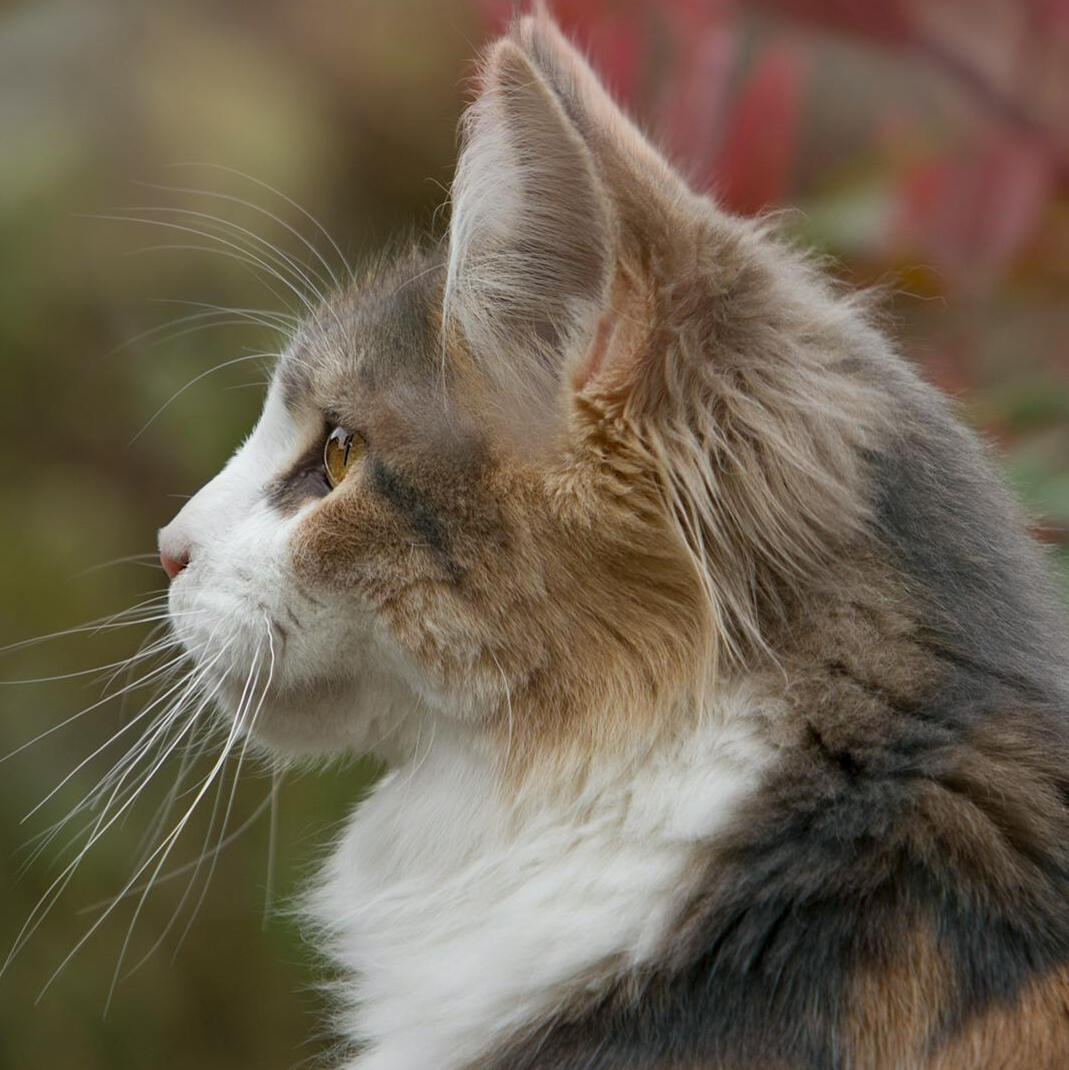
Felines

Equines

Mustelids

Other
Voice Fundamentals
To understand how to vocalize like different species, it can be helpful to first understand the mechanism we're working with. On this page, you'll learn:
The source-filter model of voice and speech production;
How we use our anatomy to produce and shape sound;
How to keep your voice healthy;
How to play and explore with your voice.
The Source-Filter Model
The Source-Filter Model is a way of describing how we make sound. It splits the process into two parts: the creation of vibration (the "source"), and the way those vibrations are shaped (the "filter"). These work together to result in the sounds that eventually reach our ears.
For example, a plucked, vibrating string of a guitar is the source of vibration, and its hollow body is a filter that shapes the sound. A brass player's buzzing lips are a source, and the size and shape of their instrument acts as the filter.
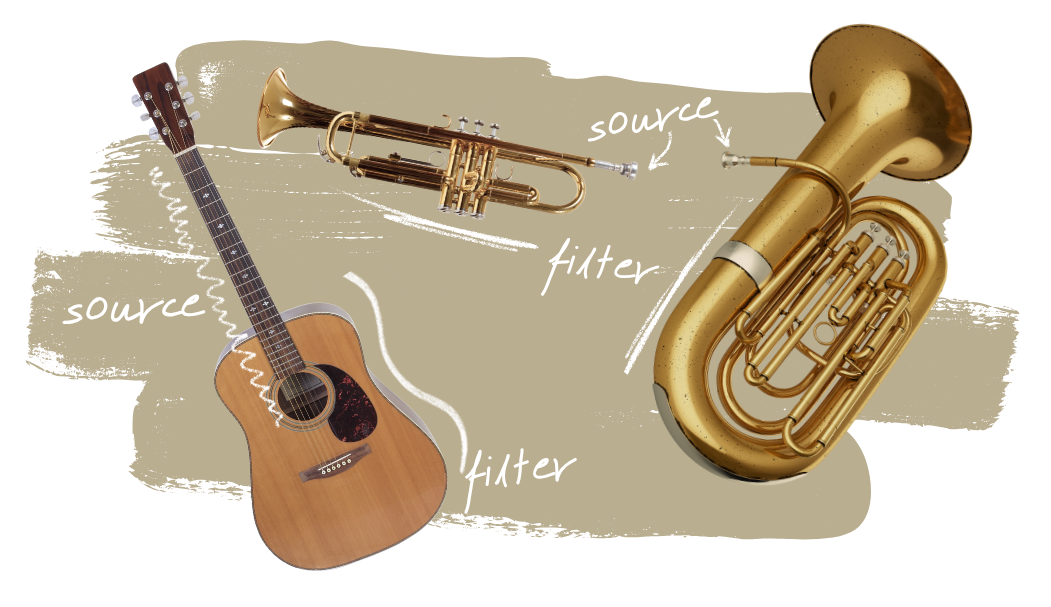
Each combination of source and filter creates a unique sound, letting us tell the difference between two instruments or two voices.
The Human Voice
For the average person, the source of vibration is the vocal folds, and the filter is the vocal tract, the pathway of sound that includes the throat, mouth, and nose. It's the precise details of these structures—size, shape, and more—that make you sound like you.
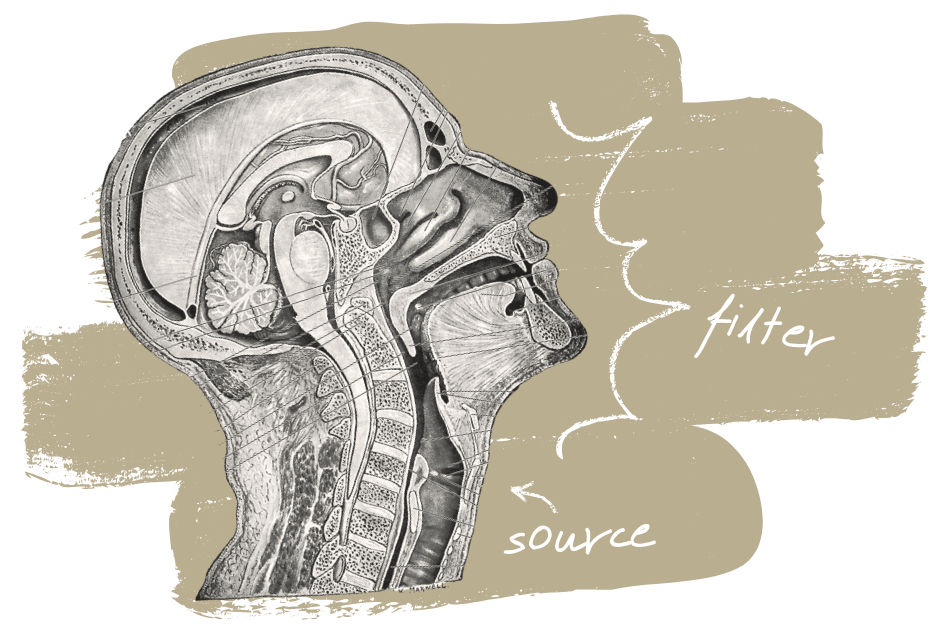
However, we aren't limited to just the vocal folds, or just the range of ways we shape sound for everyday talking. On this website, you'll learn how to use all parts of the vocal system to make animal sounds, and to give you countless ways of expressing yourself.
Controlling the Source
Respiration
When we create any sound, it's powered by air. As we exhale, air is sent up through the vocal tract and out of the nose or mouth. Along the way, it puts the source of vibration into motion.Our breathing is powered by the diaphragm, a muscle under our lungs that contracts to help them inflate. When we breath out, our abdominal muscles help push air up and out.How much and how fast can impact the sound created. For example, we'll use a fast puff of air, a slow trickle of air, a steady stream of air, and more, each of them changing how the source functions.
Vibration
Many structures in the vocal tract can be pushed into motion by airflow, creating a vibration (AKA the "source" in the source-filter model)Phonation is the the term for vibrations created by the motion of the vocal folds. These are two side-by-side muscles in your throat that vibrate when you speak and sing, and open in a V shape when you breathe. The diagram below shows a view from above.
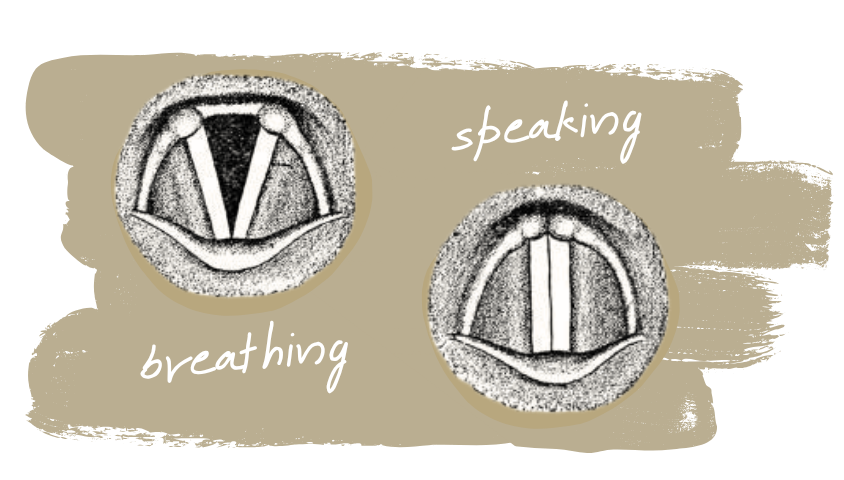
Not all sounds made by humans include vibration of the vocal folds. Linguists distinguish between "voiced sounds" and "unvoiced sounds." To feel for the difference, place a finger on your throat, close to your Adam's apple. Then, make these sounds:
| Voiced | Unvoiced |
|---|---|
| zzz | sss |
| vvv | fff |
Notice how the sounds in the left column make a vibration in your throat. These are our "voiced" sounds.The sounds in the right column do not vibrate your throat. Instead, the vibration comes from shaping airflow elsewhere in the vocal tract. For example, "sss" constricts air between the tip of your tongue and the back of your teeth. "fff" constricts air between your upper teeth and lower lip. These are some of our "unvoiced" sounds. We'll use both types to accomplish our goals.
Controlling the Filter
Place
Place describes where a sound is created. Place is described by the body parts at play. For example, in linguistic terms, a labiodental sound is made by the closing the the lower lip (labio-) and upper teeth (-dental). An alveolar sound refers to sounds made by placing the tip of the tongue on the alveolar ridge, the tissue right behind the teeth.Again, let's feel for a difference. Make these sounds, noticing what your lips and tongue are doing during each. Where in your mouth is each sound created?
| Place | Voiced | Unvoiced |
|---|---|---|
| Alveolar | zzz | sss |
| Labiodental | vvv | fff |
Use the diagram and table below to see the different places we create sounds. Don't worry about the specific terminology—we'll re-explain everything as we go!
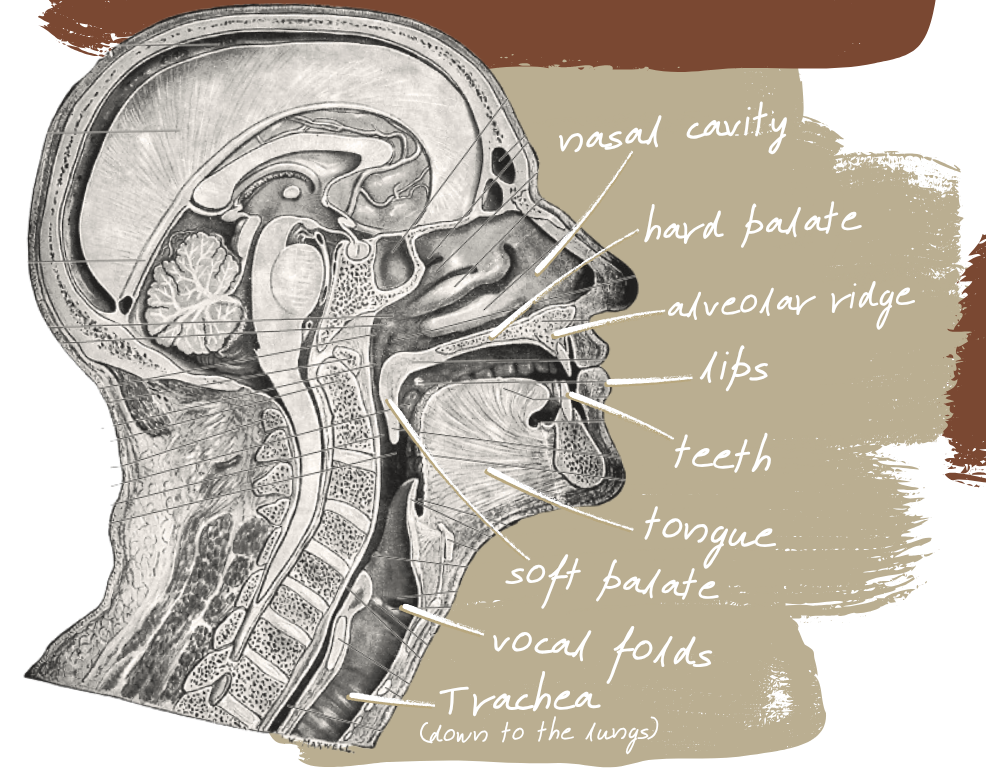
| Place | Definition | Example |
|---|---|---|
| Bilabial | Two (bi-) lips (-labial) | p, b, m |
| Labiodental | Lips (labio-) & teeth (-dental) | f, v |
| Linguadental | Tongue (lingua-) & teeth (-dental) | th |
| Alveolar | Alveolar ridge (behind upper teeth) & tongue tip | t, d, s, z, n, l |
| Palatal | Hard palate ("roof" of the mouth) & tongue back | y |
| Velar | Soft palate ("velum") & tongue back | k, g |
| Glottal | Glottis (vocal folds & area between them) | h |
Manner
Manner describes how a sound is created. For example, in linguistic terms, a fricative (like zzz, sss, vvv, or fff) is made by pushing the air through a narrow opening. A stop (like t, d, p, b) includes a complete stoppage then burst of air.
Take a look at the chart below to see the different ways we create sounds. Make some of the example sounds, noticing how the sound is created for each. Again, don't worry about the specific terminology—we'll re-explain everything as we go!
| Manner | Definition | Example |
|---|---|---|
| Stop | Complete stoppage of air, pushed open | p, b, t, d, k, g |
| Fricative | Air pushed through narrow opening | f, v, th, s, z, sh, h |
| Affricate | Starts as a stop, then becomes a fricative | ch ("church") & j/dge ("judge") |
| Nasal | Sound escapes through the nose | m, n |
| Liquid | Sounds made through partial obstruction | l, r |
| Glide | Moves between two places | w, y |
| Vowel | No constriction, sound shaped by tongue position | a, i, e, u |
Size & Shape
In our manner chart, you may have noticed vowels. We create vowels by keep the vocal tract relatively open, but changing the size and shape. Try making an "eee" sound. Then, make an "ooo" sound. What did you notice?Linguistically, we can describe vowels by if the tongue is forward or back and high or low, and if the lips are rounded or relaxed. The images below show the position of the lips and tongue during these vowels using an MRI machine.
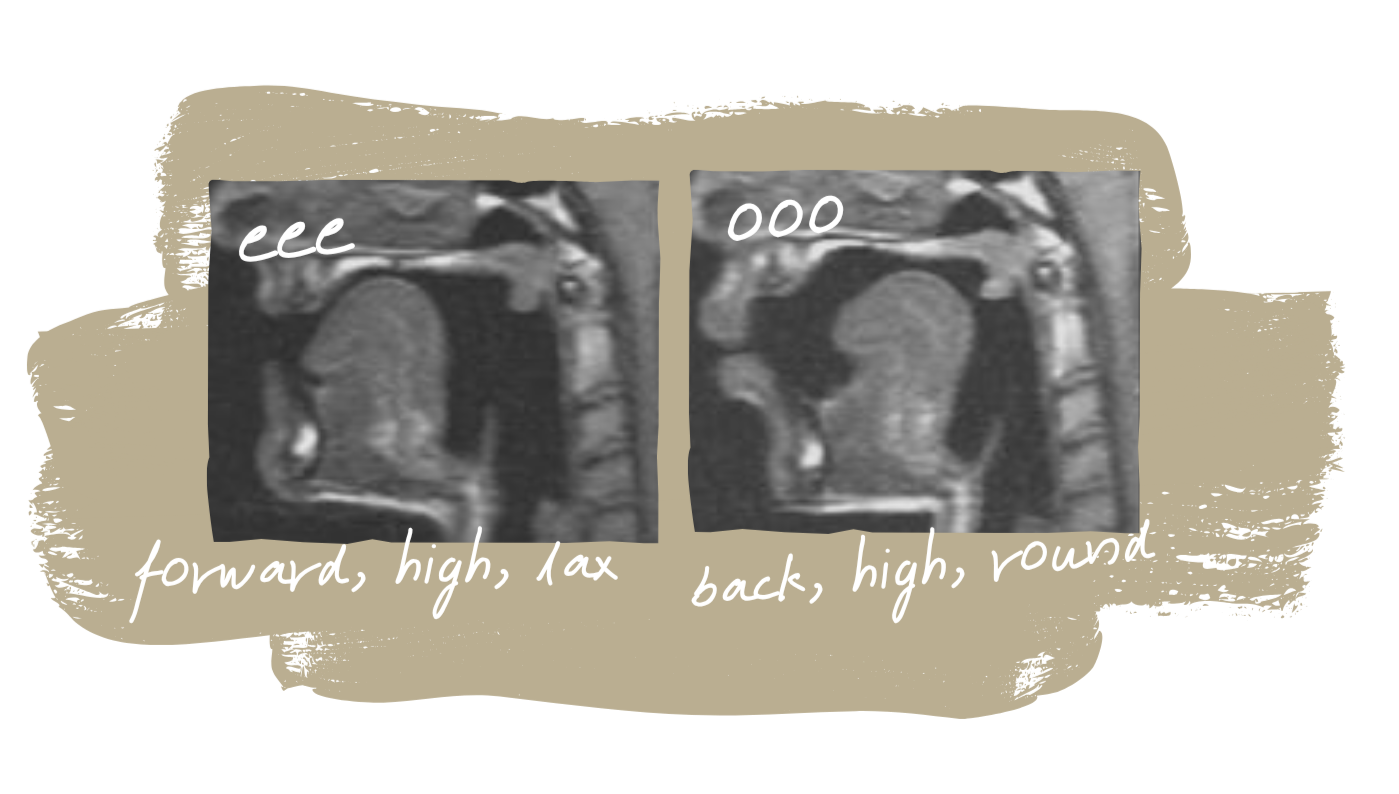
On "eee," the tongue is forward in the mouth, high towards the roof of the mouth, and the lips are relaxed. On "ooo," notice how the tongue is further back in the mouth, but still high. Also notice how the lips appear rounded during this sound.Let's explore some more. Open a video of white noise on your phone, and place the speaker in the front of your mouth. Try changing the sound by changing the size and shape of your mouth.Most sounds, not just vowels, can be shaped different ways. For example, clench your teeth and make an "mmm" sound. Then, open your jaw as wide as you can with your lips still together, and make the same "mmm" sound. It will likely sound (and feel) different.
What's Next?
The Importance of Play
Your most important skill is being able to play with your voice. If you've been trying out sounds as you read this article, congratulations, you're already an expert at playing with your voice!There's no right way to play and explore vocally, other than to do something different than your usual voice and to notice what happened. For example:
Start with speech, like an accent, character voice, or celebrity impression.
Try singing across your range, and in multiple styles.
Pick one thing to add or change, like volume, the amount of airflow, or nasality.
Jump right in and attempt your favorite animal noises.
The rest of this website contains tutorials for all sorts of sounds. However, even when you know exactly what to do, getting good at new sounds requires an open mind, trial and error, and play. Stay silly, don't take yourself too seriously, and have fun!
Keeping Your Voice Healthy
Many of the sounds you'll learn to make will use your muscles in unfamiliar ways. Listen to your body—if it hurts, stop and adjust. Remember to stay well hydrated and take things slow. Over time, you will learn how to make these sounds with less strain and effort.If you experience any of these issues, take a break from practicing until they are better:
Vocal fatigue, strain, effort, or pain
A rough, breathy, or hoarse-sounding voice
Loss of ability to use a loud or a quiet voice
Loss of parts of your pitch range
If any of these issues last longer than 4 weeks, it is important to see a medical professional, such as an ear, nose, and throat doctor.
In Conclusion
The information in this article is here to be a tool, not a requirement. If you don't get the technical pieces, don't worry! We'll always include step by step instructions in plain language.After reading this article, you should now understand some of the terms and concepts behind creating sound. In summary:
Sound starts with a source of vibration, like our vocal folds.
Sound is filtered by the size and shape of our vocal tract.
Sounds are described by the place (or where) it is created, the manner (or way it is created), and if it is voiced with the vocal folds in motion, or unvoiced with the vocal folds open.
Play and exploration are important skills when trying new sounds.
To stay healthy, listen to your body. If it hurts, adjust or take a break.
You're now ready to proceed to our other tutorials!
Canines
Canines are a family of animal including dogs, wolves, foxes, coyotes, and more.Before you begin, consider reading our page on Voice Fundamentals to understand the terms and skills referenced here!
Canine Vocal Anatomy
Canine vocal anatomy is nearly identical to human vocal anatomy, meaning many of the sounds produced by canines can be easily replicated by humans.
Canine Sounds
Barking
A bark is a short, sharp sound. It is used to signal many emotions, including excitement, alertness, fear, or a desire to play. Barks vary by species and breed. They are much more common among domestic dogs, and rarely used by wolves. They are often written with the onomatopoeia "arf," "ruff," or "woof."
Listen
Small Dogs
Medium Dogs
Large Dogs
Try It
Hold out an "rrrr" sound.
Change your mouth shape to change the quality of the sound, keeping your tongue in approximately the same "rrr" position.
Explore how the sound changes as you round or relax your lips, and if you lower or raise your jaw.
More open room in your mouth will make your bark sound like a larger breed, while less open room will make your bark sound like a smaller breed.
Maintaining this position, turn the "rrr" sound into a loud and short "ruh."
Use your abdominal muscles to power this with forceful air.
To practice this, place a hand on your stomach and cough. Notice how your abdominal muscles tense and pull in. Try this same action with the "ruh" sound.
There are three ways to end a bark:
For a sharp cutoff (heard most often with small breeds and yips), cut off the air with your vocal cords. This feels similar to the start of a cough or the middle sound in "uh oh".
For a throaty/growly cutoff (heard in larger breeds, woofs, and when growling and barking together), raise the back of the tongue even more, partially cutting off the air. To feel the back of your tongue rise, try a "k" sound, but keep it loose enough for some air to pass through.
For something in between, or a gentle cutoff, land on an "f" sound at the front of the mouth.
Try changing pitch to best resemble your desired species, breed, and emotion.
Play with types of barks. For example, a "woof" is typically and longer, lower bark that lingers on the "rrr" sound, whereas a "yip" is a shorter, higher bark.
Demos
The Science of Barking
Source
Respiration: A bark is powered by a quick exhale. To produce this forceful exhale, we use the abdominal muscles to forcefully push air out of the lungs. This may feel like tensing your belly. This is different than most breathing and speaking, which happens with slow and relaxed abdominal muscle engagement.
Vibration: This sound is voiced with the vocal folds. Pitch depends on species and breed.
Filter
Place: The tongue is raised to take up most of the room in the mouth. The front and back of the tongue are raised the highest. Linguistically, it resembles a "palatal" sound. As the sound ends, the air may be cut off by the back of the tongue raising even more, or the lips and teeth closing together, like an "f" sound (linguistically, "labiodental").
Manner: A bark is produced by a continuous stream of air. Linguistically, it resembles a "liquid," where sound moves around the sides of the tongue. As the sound ends, it morphs into a "fricative," where sound is pushed through a narrow opening.
| Sound | Place | Manner | Voicing | Other |
|---|---|---|---|---|
| Bark | Palatal | Liquid / Fricative | Voiced | Burst of air |
Growling
A growl is a low, harsh sound. It is primarily used to signal aggression, but can also be used during play. They are often written with the onomatopoeia "grrr."
Listen
Try It
Hold out an "rrrr" sound.
Glide this sound down to your lowest possible pitch.
Slow the stream of air to give the sound a "crackly" or "fry" quality.
This quality may happen naturally at your lowest pitch, or you can try to imitate a "valley girl" accent to find the feeling.
Avoid pushing or tensing your throat. This sound works best if the vocal folds are totally relaxed.
Variation can be added by changing the size of your mouth or with a burst of faster air, similar to a bark.
Explore how the sound changes as you round or relax your lips, if you lower or raise your jaw, or if you change the position of your tongue.
More open room in your mouth will make your growl sound like a larger breed, while less open room will make your growl sound like a smaller breed.
Explore combining a growl with a bark or woof sound.
ADD PALATAL /UVULAR VERSION
Demos
The Science of Growling
Source
Respiration: A growl is produced with minimal, but consistent, airflow.
Vibration: This sound is voiced with the vocal folds. The pitch of a growl will likely be your lowest possible pitch. A "fry" sound happens when the vibration of the vocal folds is irregular.
Filter
Place: Similar to a bark, the tongue is raised to take up most of the room in the mouth. The front and back of the tongue are raised the highest. Linguistically, it resembles a "palatal" sound.
Manner: A growl is produced by a continuous stream of air. Linguistically, it resembles a "liquid," where sound moves around the sides of the tongue.
| Sound | Place | Manner | Voicing | Other |
|---|---|---|---|---|
| Growl | Palatal | Liquid | Voiced | Low pitch, low airflow |
Whining / Whimpering
A whine or whimper is a high pitched sound or series of quick sounds. it is often used to express a need or discomfort. This is common in puppies.
Listen
Try It
Hold out an "rrrr" sound.
Glide this sound up to your highest possible pitch, aiming to keep your tongue in the "r" position.
From here, there are two ways to create a whine:
Through your nose: make a "mmm" sound.
Through your mouth: make a "huh" sound
Start the "h" or "m" sound at your highest pitch, quickly gliding slightly down just slightly in pitch.
This should be in falsetto, your highest vocal register, which may sound airy.
Voice cracks can work in your favor to make the sound more realistic
Round your lips slightly at the end of each sound.
Repeat this in groups of 2-3 whines.
Explore combining a whine with a bark or growl sound.
Demos
The Science of Whining
Source
Respiration: A whine is produced with consistent and smooth airflow, for short, repeated lengths.
Vibration: This sound is voiced with the vocal folds. The pitch starts very high and decreases slightly over the course of each whine.
Filter
There are two ways to whine, through your mouth, or through your nose.Place: The entire tongue is raised to take up most of the room in the mouth. Keeping the mouth only slightly open, or closed. Linguistically, it resembles a very tense "palatal" or "bilabial" sound.
Manner: A whine is produced by a continuous stream of air. Linguistically, when the mouth is open, it resembles a "liquid," where sound moves around the sides of the tongue. When the mouth is closed, it resembles a "nasal" sound, where sound leaves through the nose.Overall, the vocal tract is kept as small as possible. This is accomplished by raising the tongue and the entire voice box up in the throat.
| Sound | Place | Manner | Voicing | Other |
|---|---|---|---|---|
| Whine | Palatal / Bilabial | Liquid / Nasal | Voiced | High pitch, glides down |
Howling
A howl is a long, drawn‑out sound. It is used to communicate with and find other dogs/wolves, or to signal loneliness. It is most common among wolves, and some dog breeds such as huskies. A howl is often written with the onomatopoeia "awoo."
Listen
Demos
Try It
Try to touch your molars with the sides of your tongue, and raise the back of your tongue up.
Round your lips tightly.
Hold out a "hooo" sound at a moderately high pitch, gradually falling.
The Science of Howling
Source
Respiration: A whine is produced with consistent and smooth airflow for a long duration
Vibration: This sound is voiced with the vocal folds. The pitch starts moderately high and decreases slightly over the course of the howl.
Filter
Vowel Characteristics: The tongue is high in the mouth, pulled slightly back, and curled to create a narrow tunnel for sound to travel through. The lips are rounded.
| Sound | High / Low | Front / Back | Rounding | Other |
|---|---|---|---|---|
| Howl | High | Back | Rounded | Tongue curled |
Gekkering
Definition
Source
Respiration:
Phonation:
Filter
Place:
Manner:
| Sound | Place | Manner | Voicing |
|---|---|---|---|
| Gek | XYZ | XYZ | Voiced |
Try It
First item
Second item
Third item
Squealing
Definition
Source
Respiration:
Phonation:
Filter
Place:
Manner:
| Sound | Place | Manner | Voicing |
|---|---|---|---|
| Squeal | XYZ | XYZ | Voiced |
Try It
First item
Second item
Third item
Felines
Felines are a family of animal including domestic cats, as well as big cats such as tigers, lions, cheetahs, and more.Before you begin, consider reading our page on Voice Fundamentals to understand the terms and skills referenced here!
Feline Vocal Anatomy
Feline vocal anatomy is similar to human vocal anatomy, but has some notable exceptions. For example, cats have an extra pad of tissue on their vocal folds, allowing them to reach the low pitches that make up a purr.
Feline Sounds
Meowing
Definition
Source
Respiration:
Phonation:
Filter
Place:
Manner:
| Sound | Place | Manner | Voicing |
|---|---|---|---|
| Meow | XYZ | XYZ | Voiced |
Try It
First item
Second item
Third item
Purring
Purring is a soft, steady vibration that shows contentment. A cat's purr is very low frequency sound, typically from 20-30 Hz, or vibrations per second. Humans typically speak between 80-300 Hz, making this low of a note difficult to achieve. Cats also purr when inhaling and exhaling, which is not typical for humans. We can produce a similar sound by using different parts of the body.
Source
Respiration: A purr is produced with strong and steady airflow.
Phonation: To reach the low frequencies of a purr, we will not be phonating with the vocal folds. Instead, we will vibrate the tip of the tongue.
Filter
Place: The tongue is raised to take up most of the room in the mouth. The front and back of the tongue are raised the highest. The tip of the tongue should be near the alveolar ridge - the bump right behind your teeth.
Manner: A purr is produced by a continuous stream of air putting the tip of the tongue into motion. This is called a "trill." It is similar to a "rolled R" in Spanish.
| Sound | Place | Manner | Voicing |
|---|---|---|---|
| Purr | Alveolar | Trill | Unvoiced |
Try It
Make an "t" sound and hold this mouth position. This will place your tongue in the correct spot. Keep the tip of your tongue as relaxed as possible.
Gently and steadily blow air. You should feel the tip of your tongue put into motion.
Alternatively, if you roll your R's, make that sound. Place a finger on your throat to feel your vocal folds vibrate. Keeping everything the same, just blow air, taking away the vibration in your throat. Thill will put your tongue into motion.
Chuffing
Definition
Source
Respiration:
Phonation:
Filter
Place:
Manner:
| Sound | Place | Manner | Voicing |
|---|---|---|---|
| Chuff | XYZ | XYZ | Voiced |
Try It
First item
Second item
Third item
Equines
Equines refer to horses, zebras, and similar animals.
Equine Vocal Anatomy
Equine vocal anatomy is similar to humans, however, there are several key differences. Horses have reduced control over the range of pitches and sounds they can make, resulting in a small number of sounds. Their long nose and muzzle contribute to a distinct sound.
Equine Sounds
Neigh
Nicker
Blow
Snort
Mustelids
Thanks for your patience.
Mustelid Vocal Anatomy
Felines are a family of animal including domestic cats, as well as big cats such as tigers, lions, cheetahs, and more.
Mustelid Sounds
Squeaking
Chittering
Trilling
Barking
other
There are countless animals not yet included on this site. Have a request? Let us know:
What are therian vocals?
A therian is a person who experiences being and identifies as a non-human animal on an integral, personal level.1Therian vocals include making the noises of one's theriotype (the animal they identify with). Making these sounds can be a lot of fun, and help a therian feel more connected to their identity.Our goal is to help you use your voice safely and easily.
Voice Fundamentals
To understand how to vocalize like different species, it can be helpful to first understand the mechanism we're working with. On this page, you'll learn:
The source-filter model of voice and speech;
How we use our bodies to produce and shape sound;
The language linguists use to describe the ways to make our target sounds.
The Source-Filter Model
All sounds are created from a source of vibration and a filter that shapes those vibrations. For example, the vibrating strings of a guitar are the source of vibration, and its hollow body is a filter that shapes the sound before it ultimately reaches our ears.With most speech, the source of vibration is our vocal folds, and the filter is the vocal tract, encompassing the throat, mouth, and nose. The way we create and shape the voice give us countless ways of expressing ourselves.
Source
All sound is made of vibration. A vibration source can be many things, such as a plucked guitar string, a stick striking a drum, or the buzzing lips of a brass player. Below, you'll learn about the common ways we create soundscwith our vocal mechanism.
Step 1: Respiration
When we create any sound, it is powered by air. As we exhale, air is sent up through the vocal tract and out of the nose and mouth. Along the way, it puts the source of vibration into motion. How much and how fast can impact the sound created,
Step 2: Vibration
Many structures in the vocal tract can be pushed into motion by airflow, creating a vibration.Phonation is the the term for vibrations created by the motion of the vocal folds, two side-by-side muscles that vibrate when we speak and sing, and open in a V shape when we breathe. These muscles, about the size of your fingernail, are what allows you to speak.Not all sounds made by humans include vibration of the vocal folds. Linguists distinguish between "voiced sounds" and "unvoiced sounds."Let's feel for the difference. Place a finger on your throat, close to your Adam's apple. Then, make these sounds:
| Voiced | Unvoiced |
|---|---|
| zzz | sss |
| vvv | fff |
Notice how the sounds in the left column make a vibration in your throat. These are our "voiced" sounds.The sounds in the right column do not vibrate your throat. Instead, the vibration comes from constricting airflow elsewhere in the vocal tract. For example, "sss" constricts air between the tip of your tongue and the back of your teeth. "fff" constricts air between your upper teeth and lower lip. These are some of our "unvoiced" sounds.While many animal sounds are made by vibrating your vocal folds, we'll use all sorts of structures, such as your lips, tongue, and palate.
Filter
Once created by the source, sound is filtered by the size and shape our throat, mouth, and nose on its way out of our bodies.We also use our tongues, lips, teeth, and more to constrict the sound in different ways, called articulation, to create the sounds of speech.
Place
Place describes where a sound is created. All consonants have a place, including voiced and unvoiced sounds.Place is described by the body parts at play. For example, a "labiodental" sound is made by the closing the the lower lip (labio-) and upper teeth (-dental). An "alveolar" sound refers to sounds made by placing the tip of the tongue on the alveolar ridge, the tissue right behind the teeth.Again, let's feel for a difference. Make these sounds, noticing what your lips and tongue are doing during each. Where in your mouth is each sound created?
| Place | Voiced | Unvoiced |
|---|---|---|
| Alveolar | zzz | sss |
| Labiodental | vvv | fff |
Place Chart
Use the table below to see the different places we create sounds. Don't worry about the specific terminology - we'll re-explain everything as we go!
| Place | Definition | Example |
|---|---|---|
| Bilabial | Two (bi-) lips (-labial) | p, b, m |
| Labiodental | Lips (labio-) & teeth (-dental) | f, v |
| Linguadental | Tongue (lingua-) & teeth (-dental) | th |
| Alveolar | Alveolar ridge (behind upper teeth) & tongue tip | t, d, s, z, n, l |
| Palatal | Hard palate ("roof" of the mouth) & tongue back | y |
| Velar | Soft palate (above uvula) & tongue back | k, g |
| Glottal | Glottis (vocal folds & area between them) | h |
Knowledge Check:
Which bilabial sounds are voiced? Unvoiced?
Answer:
Manner
Manner describes how the sound is being created. All consonants have a manner, including both voiced and unvoiced sounds.Manner is described by linguistic terms. For example, a fricative (like zzz, sss, vvv, or fff) is made by pushing the air through a narrow opening. A stop (like t, d, p, b) includes a complete stoppage then burst of air.Take a look at the expanded chart below, and let's feel for a difference. Make these sounds, noticing what your lips and tongue are doing during each. Pay attention to not only where the sound is creased, but how it is created: a steady stream of air, a complete stoppage, etc.
| Place | Manner | Voiced | Unvoiced |
|---|---|---|---|
| Alveolar | Fricative | zzz | sss |
| Labiodental | Fricative | vvv | fff |
| Alveolar | Stop | d | t |
| Bilabial | Stop | b | p |
Manner Chart
| Manner | Definition | Example |
|---|---|---|
| Stop | Complete stoppage of air, pushed open | p, b, t, d, k, g |
| Fricative | Air pushed through narrow opening | f, v, th, s, z, sh, h |
| Affricate | Starts as a stop, then becomes a fricative | ch ("church") & j/dge ("judge") |
| Nasal | Sound escapes through the nose | m, n |
| Liquid | Sounds made through partial obstruction | l, r |
| Glide | Moves between two places | w, y |
Size & Shape
While the concepts above apply to consonants, vowels behave differently. We create vowels by keep the vocal tract relatively open while changing the size and shape. Try making an "eee" sound. Then, make an "ooo" sound. What did you notice?In both cases, you likely had your vocal folds vibrating, but it's harder to choose a specific place or manner. That's because the pathway of the sound is more open. Notice what differences did happen - from your lips rounding to how your tongue moved. Linguistically, we can describe vowels by how round the lips are, and forward/back, and high/low the tongue is.
| Sound | High / Low | Front / Back | Rounding | Voicing | Other |
|---|---|---|---|---|---|
| Howl | High | Back | Rounded | Voiced | Tongue curled |
Let's try it out some more. Open a video of white noise on your phone, and place the speaker in the front of your mouth. Try changing the sound by changing the size and shape of your mouth.Some consonants can also be shaped different ways. For example, clench your teeth and make an "mmm" sound. Then, open your jaw as wide as you can with your lips still together, and make the same "mmm" sound. It will likely sound and feel different.
Putting it Together
With this linguistics crash course out of the way, let's try an animal sound! How about an easy one, a hiss.Make a hiss, and notice what your mouth does. Most likely, your vocal folds are not vibrating (unvoiced), your tongue tip is behind your teeth (alveolar), and the air is moving constantly through a narrow opening making a noisy sound (fricative).If we were to describe a hiss, like a snake's, we would call it an "unvoiced alveolar fricative," or simply, the "s" sound in English.
| Sound | Place | Manner | Voicing |
|---|---|---|---|
| Snake Hiss (sss) | Alveolar | Fricative | Unvoiced |
However, what about a cat's hiss? Try making this sound on your own, and take a guess at how to describe it. It's okay to not have the exact linguistic or anatomical terms in mind.
| Sound | Place | Manner | Voicing |
|---|---|---|---|
| Cat Hiss |
How did you do?
Keeping Your Voice Healthy
Many of the sounds you'll learn to make will use your muscles in unfamiliar ways. Over time, you'll learn how to make these with less strain and effort. Remember to stay well hydrated and take things slow.If you experience any of these issues, take a break from practicing:
Vocal fatigue, strain, effort, or pain
A rough, breathy, or hoarse-sounding voice
Loss of ability to use a loud or a quiet voice
Loss of parts of your pitch range
If any of these issues last longer than 4 weeks, it is important to get evaluated by a medical professional, such as an ear, nose, and throat doctor.
In Conclusion
After reading this article, you should now understand some of the concepts and terms behind creating sound. In summary:
Sound starts with a source of vibration, like our vocal folds.
Sounds can be voiced, with the vocal folds in motion, or unvoiced with the vocal folds open.
Sound is filtered by the size and shape of our vocal tract.
Consonants are described by the place (or where) it is created, and the manner (or way it is created).
Vowels are descirbed by how round the lips are, and forward or back and high or low the tongue is.
We use anatomical and linguistic terms to get specific about the place, manner, and voicing of a sound.
You're now ready to proceed to our other tutorials!